Skip to content
 EN
EN  ZH
ZH 
How Quality Ergonomics Reduces Staff Turnover & Burnout

This article is for informational purposes only and is not a substitute for professional medical or ergonomic advice. Consult a qualified professional before making significant changes to your workspace, especially if you have pre-existing health conditions.
As clinic owners and practice managers, we are conditioned to focus on patient-centric investments. We upgrade our diagnostic tools, improve the waiting room, and invest in patient comfort. But what if one of the most powerful levers for boosting profitability and operational stability isn’t about the patient at all? The conversation around dental chairs often centers on patient experience or treatment capabilities. This overlooks a critical business reality: the direct impact of practitioner ergonomics on staff retention, burnout, and your bottom line.
Investing in high-quality ergonomic dental chairs is a strategic intervention that directly reduces the hidden costs of staff turnover and absenteeism. It moves the purchase from a capital expenditure to a core component of a sustainable human resource strategy. By focusing on the well-being of your clinical team, you create a more resilient, efficient, and profitable practice.
The Hidden Costs of Poor Ergonomics
Practitioner burnout and physical strain are not just personal issues; they are significant financial drains on a dental practice. The repetitive motions, sustained awkward postures, and constant muscle tension inherent in dental work contribute to a high prevalence of musculoskeletal disorders (MSDs). Research published on PubMed consistently highlights that dentists, hygienists, and assistants are at high risk for chronic pain, particularly in the neck, back, and shoulders. This physical toll translates directly into business costs.
- Increased Staff Turnover: When skilled practitioners leave due to chronic pain or burnout, the replacement costs are substantial. These include recruitment fees, training time for the new hire, and the lost productivity during the transition. A high turnover rate can easily cost a practice tens of thousands of dollars per year.
- Higher Absenteeism: Staff suffering from MSDs take more sick days. This leads to lost revenue from canceled appointments, scheduling chaos, and the potential cost of hiring temporary staff.
- Reduced Productivity: Even when present, a practitioner in pain is not working at full capacity. Their focus may be divided, procedures can take longer, and the risk of errors increases. This “presenteeism” quietly erodes the efficiency and profitability of the clinic.
Ignoring ergonomics is no longer a viable option in a competitive market. As the global demand for dental services grows, a trend confirmed by market analysis from firms like MarketsandMarkets, retaining skilled staff becomes a key competitive advantage. The physical well-being of your team is inseparable from the financial health of your practice.
Key Ergonomic Features That Drive Business Value
Understanding ergonomic features is not about technical specifications; it’s about connecting those features to tangible business outcomes. A truly ergonomic chair isn’t a luxury—it’s a tool designed for performance and longevity. My experience in analyzing clinic operations has shown that the right adjustments can dramatically reduce physical strain and improve daily work life.
Foundational Adjustments for Practitioner Health
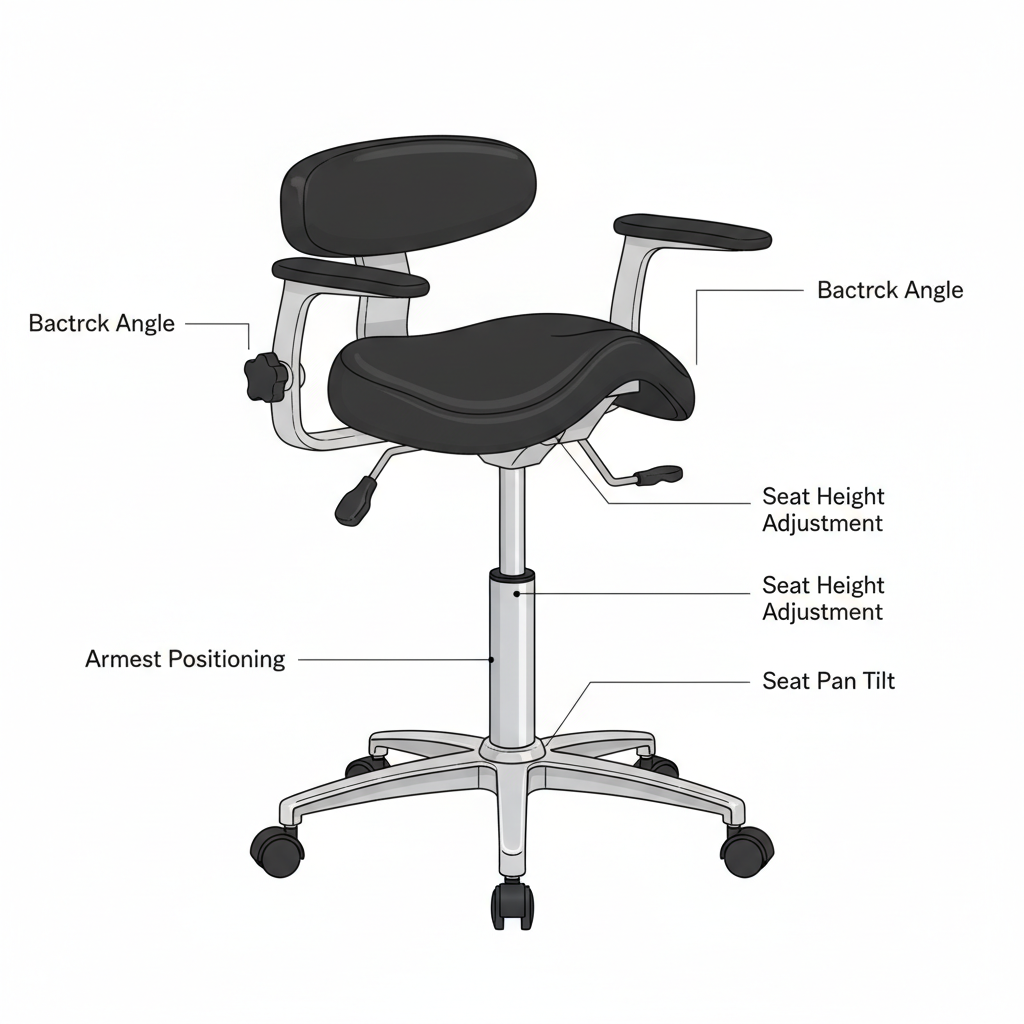
A common mistake I see is clinics purchasing chairs based on appearance rather than granular adjustability. True ergonomics begins with fitting the chair to the practitioner, not the other way around. Here are the non-negotiable adjustment points that matter:
- Clinician Stool Height: The goal is to keep the forearms parallel to the floor when working with the instrument tray. For most adults, this corresponds to a seat height between 43–53 cm. This neutral position minimizes strain on the shoulders and upper back.
- Seat Pan Tilt: For procedures that require leaning forward, a forward seat pan tilt of 5°–10° is crucial. This small adjustment rotates the pelvis, helping to maintain the natural curve of the lower back (lumbar spine) and reducing disc pressure.
- Armrest and Assistant Tray Positioning: Armrests and trays should support a neutral shoulder position, with the upper arms close to the body. This means avoiding abduction (lifting the arm out to the side) of more than 20°. Proper positioning prevents rotator cuff strain and neck pain.
These adjustments directly combat the daily accumulation of micro-traumas that lead to chronic injury. By keeping your team within these ergonomic zones, they can perform their duties with greater comfort and focus, leading to fewer errors and higher-quality patient care.
Myth Debunked: “Any Adjustable Chair is an Ergonomic Chair”
A prevalent and costly misconception is that any chair with levers for height and backrest adjustment qualifies as “ergonomic.” This is fundamentally incorrect. The value of an ergonomic chair lies in the range and precision of its adjustments and its ability to support the body in dynamic postures.
Many standard chairs lack the forward-tilt capability essential for dental work or have armrests that are not sufficiently adjustable, forcing practitioners into compromised positions. Furthermore, a chair’s value is only realized when the staff is trained to use it properly. I have seen practices invest in excellent equipment, only to have it remain in its default factory settings because no one explained how or why to adjust it. True ergonomic integration requires both the right equipment and dedicated training on its features.
Measuring the ROI of Your Ergonomic Investment
An investment in quality ergonomic seating is not an expense; it is a capital improvement that yields measurable returns. To make the business case clear, clinic managers should move beyond simple cost and calculate a tangible ROI. The payback period for this type of investment is often surprisingly short, typically ranging from 6 to 24 months, depending on the clinic’s baseline staff turnover and absenteeism rates.
Here is a simple model to calculate the annual savings:
Annual Savings = (Turnover Reduction Savings) + (Sick Day Reduction Savings) + (Productivity Gain)

To put this into practice, you can use the following framework to estimate your potential return.
ROI Calculation Framework
| Metric | Calculation Step | Example | Your Clinic’s Data |
|---|---|---|---|
| 1. Turnover Cost | (Number of staff who left last year) x (Fully-burdened hiring cost per employee) | 2 employees x $15,000 = $30,000 | ___ x $___ = $___ |
| 2. Sick Day Cost | (Total sick days last year) x (Average daily labor cost per employee) | 20 days x $400/day = $8,000 | ___ days x $___/day = $___ |
| 3. Total Annual Cost | Turnover Cost + Sick Day Cost | $30,000 + $8,000 = $38,000 | $___ + $___ = $___ |
| 4. Projected Reduction | Total Annual Cost x (Projected % reduction, e.g., 20%) | $38,000 x 0.20 = $7,600 | $___ x 0.___ = $___ |
| 5. Payback Period | (Cost of New Ergonomic Chairs) / (Projected Annual Savings) | $15,000 / $7,600 = ~1.97 years | $___ / $___ = ___ years |
This calculation provides a conservative estimate, as it doesn’t even include the softer benefits like improved morale or the productivity gains from saving a few minutes on each procedure.
A Practical Implementation Strategy
Successfully integrating ergonomic equipment requires more than just a purchase order. It demands a thoughtful rollout plan to maximize adoption and ensure you capture the expected benefits. Rushing a practice-wide change can lead to resistance and improper use.
I always recommend a pilot program approach:
- Select One Operatory: Choose one of your operatories to be the test environment. Install the new ergonomic chair and stool here.
- Train a Small Group: Train the dedicated team for that operatory on every feature of the new equipment. Have them practice adjusting the chair for different procedures and users.
- Track KPIs for 3 Months: Before the pilot, establish baseline metrics. During the three-month trial, track these same KPIs for the pilot team:
- Staff-reported discomfort (using a simple 1-5 scale).
- Procedure time variance.
- Sick days or requests for time off.
- Gather Feedback and Iterate: Hold regular check-ins with the pilot team. What do they like? What adjustments have been most helpful? Use this feedback to refine your training and adjustment protocols.
- Develop a Widescale Rollout Plan: Once the pilot proves successful and you have a clear set of best practices, you can confidently roll out the new chairs to the rest of the practice.
Finally, consider the total cost of ownership. Opt for chairs with features that extend their usable life, such as modular upholstery that can be easily replaced and sealed electrical controls to prevent damage and reduce downtime. Investing in equipment that meets robust quality standards, such as those outlined by ISO 13485:2016, ensures that the chair is not only ergonomically sound but also built for durability and safety, protecting your investment for years to come.
Key Takeaways
Viewing ergonomic dental chairs through a business lens reveals their true value. They are not merely a matter of comfort but a cornerstone of a financially sound and human-centric dental practice. By systematically reducing the physical strain on your clinical team, you directly combat the root causes of burnout and high turnover.
This strategic investment leads to a more stable, experienced, and productive staff, which in turn delivers higher quality patient care and a stronger bottom line. By implementing a measured, data-driven approach to ergonomic upgrades, clinic owners can build a more resilient practice prepared for long-term growth.
References
About the Author