
 EN
EN  ZH
ZH 
How Upholstery Quality Affects Long-Term ROI

Your Dental Chair: An Asset Designed to Endure
Your dental chair is one of the most significant capital investments in your clinic. It is a primary tool for patient care, a centerpiece of the treatment room, and a long-term asset. While the initial purchase price is a key consideration, savvy clinic owners and procurement managers understand that the total cost of ownership (TCO) is a far more critical metric. A surprising amount of that TCO is tied to a single component: the upholstery.
Choosing high-durability, easy-to-maintain upholstery is not a matter of luxury; it is a calculated business decision that directly impacts your long-term return on investment. It can dramatically lower repair costs, reduce clinic downtime, and enhance infection control, protecting both your patients and your bottom line.
The Anatomy of High-Performance Upholstery
Not all upholstery is created equal. Understanding its construction is the first step toward making a smarter investment. Quality is determined by the synergy of its components, from the surface you see to the seams that hold it together.
Beyond the Surface: Layers of Durability
High-performance medical-grade upholstery is a multi-layered system designed for longevity and hygiene. It typically consists of:
- Topcoat: This is the outermost protective layer. A quality topcoat resists abrasion, stains, and chemical breakdown from disinfectants. It provides a non-porous barrier essential for infection control.
- Upholstery Layer: This is the flexible, durable material itself, often a high-grade polyurethane or vinyl. Its thickness and composition determine its resistance to punctures, tears, and cracking under the stress of daily use.
- Foam Core: The foam provides comfort and support. High-resilience (HR) foam is the standard for quality. It resists compression and sagging, which is a common failure point I see in lower-cost chairs. Expect visible indentation and loss of support within just one to two years with low-density foams, whereas HR foam maintains its integrity for much longer.
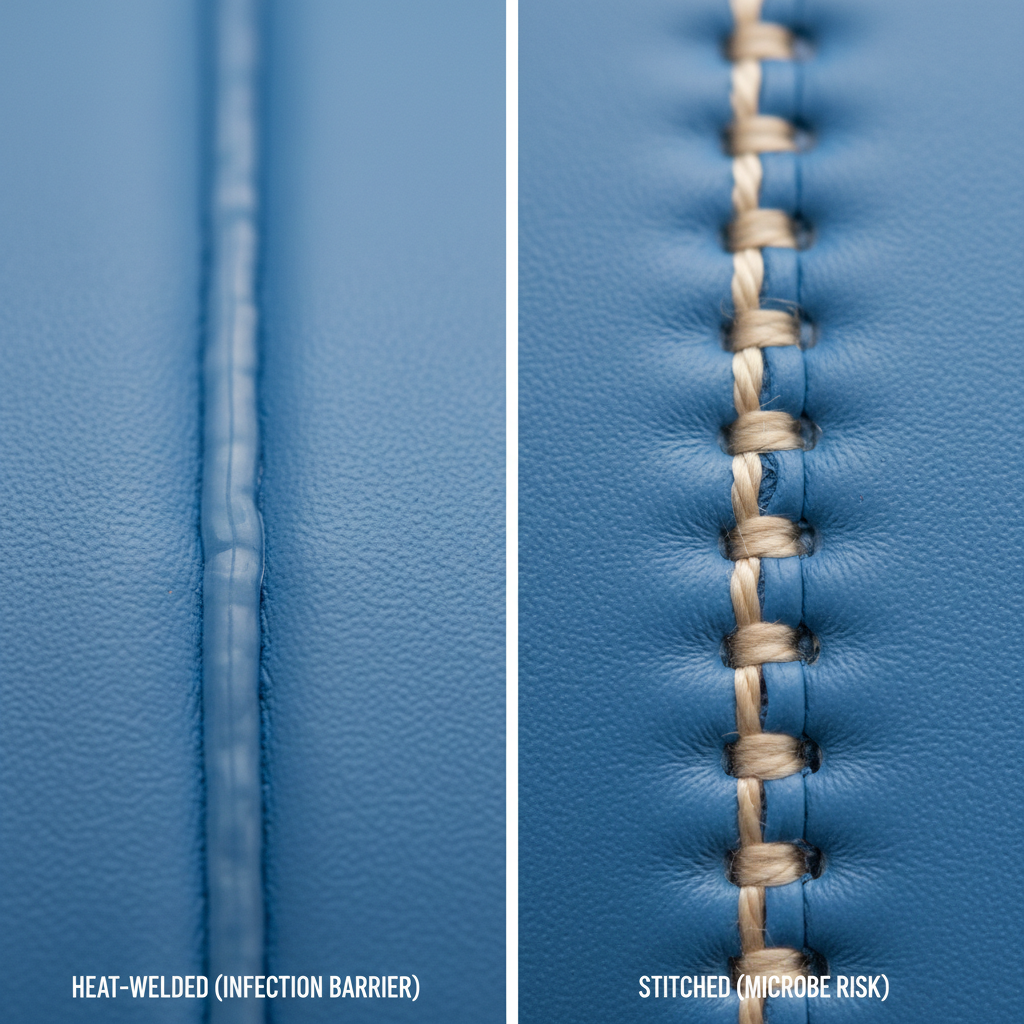
Seams and Stitching: A Critical Point of Failure
A common mistake is overlooking how the upholstery is joined. This is often where failures begin. Stitched seams, while common in residential furniture, create thousands of tiny perforations. In a clinical setting, these holes can trap fluids and microorganisms, making effective disinfection nearly impossible and increasing repair risk.
I always recommend welded or heat-sealed seams. This technique bonds the material together without punctures, creating a continuous, impervious surface. This design is fundamentally better for infection control and far more durable, as it eliminates the thread that can degrade or break over time.
Material Durability and Its Financial Impact
The lifespan of your chair’s upholstery directly translates to your clinic’s financial health. Frequent replacements mean not only material and labor costs but also unproductive downtime for the treatment room.
Common Failure Modes and Their Costs
From years of experience in clinical environments, I’ve observed that upholstery in a busy practice typically has a lifespan of 5–8 years, while chairs in lower-use settings might last 8–12 years. The most common failures are:
- Seam Failure: Stitched seams unravel or tear, compromising hygiene and aesthetics.
- Topcoat Abrasion: The protective layer wears away, especially in high-contact areas, leading to discoloration and cracking.
- Foam Compression: The cushion compacts and sags, becoming uncomfortable for patients and unsupportive for the practitioner.
Replacing upholstery is a significant expense that goes beyond the material itself. It involves labor costs and, critically, operational downtime. Every hour a chair is out of service is an hour of lost revenue.

Calculating the True Cost of Ownership: An Analysis
Focusing on the initial price tag is a classic procurement error. A cheaper chair that requires upholstery replacement twice in a decade is far more expensive than a premium chair that requires it only once. A simple rule I use: if a higher-quality material helps you skip just one replacement cycle over ten years, your net lifetime cost often drops by 20–30% in a high-traffic clinic.
Let’s model this out for a high-use clinic over a 10-year period:
| Cost Factor | Standard Upholstery (Lower Initial Cost) | High-Performance Upholstery (Higher Initial Cost) |
|---|---|---|
| Initial Cost | $500 | $1,500 |
| Lifespan | 5 Years | 10 Years |
| Replacements in 10 Yrs | 1 (at Year 5) | 0 |
| Cost of Replacement | $1,200 (Parts & Labor) | $0 |
| Downtime Cost | $500 (Estimated revenue loss) | $0 |
| Total 10-Year Cost | $2,200 | $1,500 |
This analysis shows that the chair with the higher upfront cost is actually 32% cheaper over a decade. This is the power of investing in durability.
Infection Control and Regulatory Compliance
In a dental practice, every surface must be cleanable to prevent cross-contamination. Upholstery is no exception and is a key part of your infection control protocol.
Cleanability as a Core Feature
Materials with smooth, non-porous, and continuous coated surfaces are easier to clean and disinfect effectively. This is crucial for breaking down biofilm. Daily wipe-downs with a neutral-pH cleaner and weekly disinfection with an approved agent are standard practice. However, it’s critical to use cleaners specified by the manufacturer. I’ve seen many chairs ruined by the prolonged use of solvents or high-alcohol cleaners, which can make the upholstery brittle and cause it to crack prematurely.
Ensuring your equipment meets high standards for quality and safety is also a regulatory requirement. For medical devices sold in international markets, compliance with standards like ISO 13485:2016 – Quality Management Systems is essential. This demonstrates a commitment to quality control throughout the manufacturing process. Similarly, devices sold in the United States must adhere to the FDA’s Quality System Regulation, while those in Europe require CE Marking to prove they meet health and safety standards.
Common Procurement Mistakes to Avoid
Making the right choice requires looking past the surface. Many clinics make predictable and costly errors during procurement.
Myth: Upholstery is Just About Aesthetics
A common myth is that upholstery choice is primarily about matching clinic decor or getting the lowest price. In reality, the material’s performance characteristics—cleanability, durability, and repairability—are far more important for long-term value. Prioritizing color over composition is a recipe for future expenses.
To avoid these pitfalls, use this procurement checklist:
- Verify Seam Construction: Ask for welded or heat-sealed seams. If a stitched seam is unavoidable, ask for details on thread type and density.
- Confirm Foam Specifications: Request high-resilience (HR) foam. Don’t settle for vague terms like “high-density.”
- Check Disinfectant Compatibility: Get a list of approved cleaning agents and protocols. Ensure they align with your clinic’s infection control procedures.
- Inquire About Serviceability: Confirm the availability of spare parts and the presence of local service technicians. A chair that can’t be serviced is a chair that can’t earn revenue.
- Prioritize Function over Fashion: Choose the material based on its performance data, not just its color swatch.
Wrapping Up: Your Upholstery is an Investment
Choosing the right upholstery for your dental chairs is a strategic decision that pays dividends for years. By prioritizing material durability, seamless construction, and proven cleanability, you reduce your total cost of ownership and enhance patient safety. Look beyond the initial price and focus on the long-term ROI. A high-performance chair with quality upholstery is not an expense—it’s a durable asset that supports your practice’s financial health and reputation.
Disclaimer: This article is for informational purposes only and does not constitute professional medical or financial advice. Equipment decisions should be made in consultation with procurement specialists and financial advisors, considering the specific needs and regulations applicable to your practice.
References
About the Author