Skip to content
 EN
EN  ZH
ZH 
Compressor Sizing: A Tech Guide for Dental Clinics

Selecting the right air compressor for a dental clinic is a foundational decision that impacts everything from instrument performance to operational uptime. A system that is too small will fail to keep up with demand, leading to pressure drops, wet air, and premature equipment failure. An oversized unit, on the other hand, results in wasted energy and unnecessary capital expenditure. This guide provides a technical framework for accurately assessing your clinic’s needs to choose a compressor that delivers reliable, clean, and dry air.
Getting this right is about more than just convenience; it’s a matter of operational integrity and patient safety. The quality of compressed air directly affects the longevity of expensive handpieces and the efficacy of dental procedures. Let’s get into the technical details of proper sizing.
Why Correct Sizing Matters
I’ve visited many clinics where puzzling performance issues, like a high-speed handpiece feeling sluggish during a procedure, were traced back to an undersized compressor. The staff often blamed the tool, but the root cause was insufficient air pressure and flow. This is a classic sign of a system struggling to meet peak demand.
When a compressor is too small, it runs constantly, leading to overheating and forcing moisture-laden air into the lines. This condensate can damage the delicate bearings in a handpiece, leading to costly repairs and downtime. Conversely, a grossly oversized compressor will short-cycle frequently, leading to excessive wear on its motor and electrical components, not to mention a higher electricity bill.
Proper sizing ensures your tools receive the consistent pressure and airflow they need to operate as designed, protecting your investment and ensuring predictable performance. It also aligns with the stringent quality control expectations outlined in standards like ISO 13485:2016 – Quality Management Systems, which mandate that equipment performs reliably and safely.
The Core Metrics: Understanding Air Demand & Flow
Before you can size a compressor, you need to understand the language of compressed air. The two most important metrics are Free Air Delivery (FAD) and pressure.
- Free Air Delivery (FAD): This is the volume of air the compressor can deliver at a specific pressure. It’s typically measured in Liters per minute (L/min) or Cubic Feet per Minute (CFM). This is the single most important factor in sizing.
- Pressure: Measured in pounds per square inch (PSI) or bar, this is the force of the air. Most dental instruments operate in the 80-100 PSI (5.5-7 bar) range.
Debunking a Common Myth: Average vs. Peak Demand
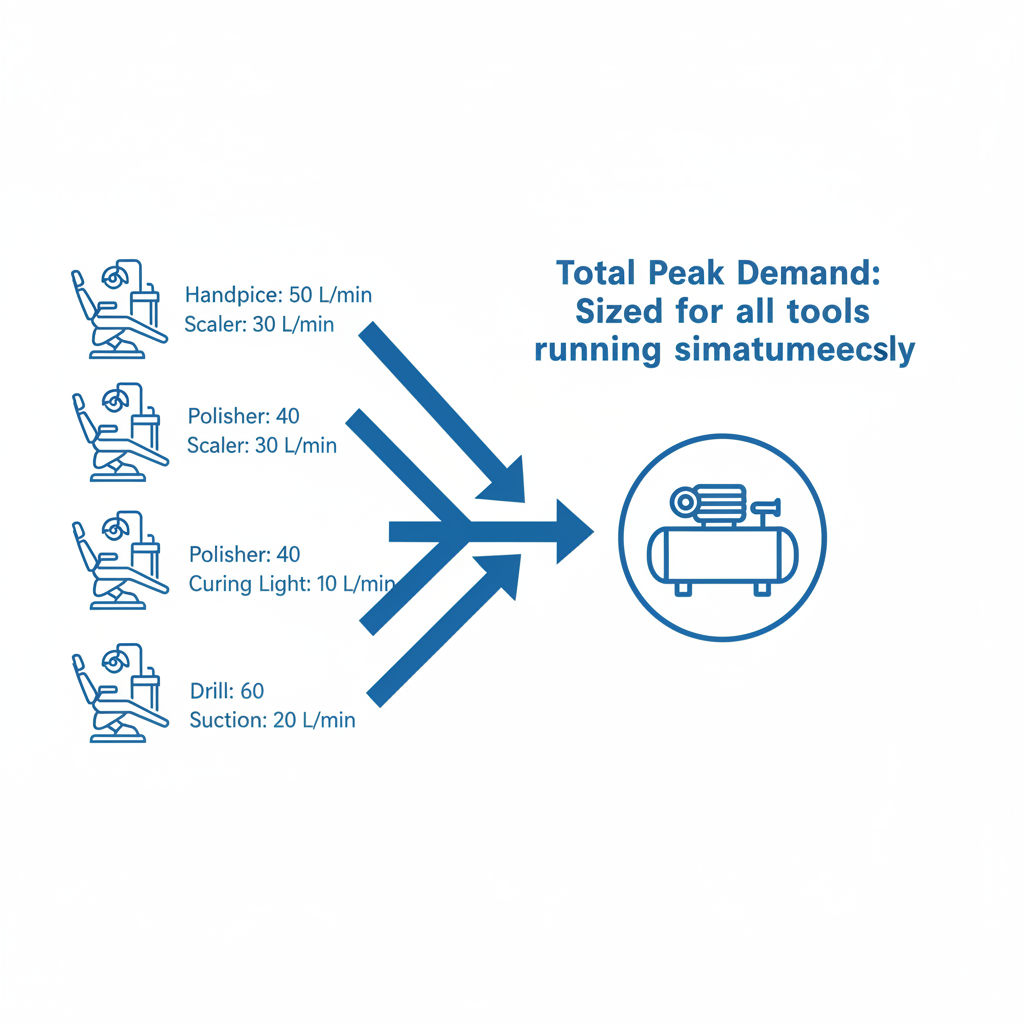
A frequent and costly mistake is sizing a compressor based on the average air consumption of your instruments. A clinic’s air demand is never steady; it is characterized by sharp peaks when multiple users operate high-consumption tools simultaneously. Sizing for the average will guarantee failure during these critical peak moments. You must always size for peak demand.
To calculate this, you need to know the consumption of your specific tools. Here is a table of typical values.
| Instrument | Typical Peak Air Consumption (L/min) |
|---|---|
| High-Speed Air Turbine Handpiece | 30–60 |
| Air Scaler | 20–40 |
| Air-Driven Polisher | 25-50 |
| 3-in-1 Syringe | 15-25 |
| CAD/CAM Milling Machine | 100-150+ (Check manufacturer specs) |
Sizing Your System: A Step-by-Step Calculation
Follow this process to accurately estimate your clinic’s total air demand.
Step 1: List All Air-Consuming Devices
Create an inventory of every single piece of equipment in your clinic that uses compressed air. Do this for every operatory. Don’t forget lab equipment or tools used for cleaning and maintenance.
Step 2: Determine Peak Consumption for Each Device
Using the table above and, more importantly, the manufacturer’s specifications for your actual equipment, find the peak FAD requirement for each device. Sum these numbers to get your theoretical maximum demand.
Step 3: Apply a Diversity Factor
It is unlikely that every single air-powered tool in your clinic will run at the exact same moment. The diversity factor is a multiplier (between 0.4 and 0.8) that accounts for a more realistic concurrent usage pattern.
- Small Clinics (1-3 chairs): Use a higher diversity factor (e.g., 0.7-0.8), as it’s more probable that a high percentage of your tools will be in use at once.
- Larger Clinics (4+ chairs): You can use a lower diversity factor (e.g., 0.4-0.6), as the usage patterns are spread across more operators. For example, in a well-designed small clinic layout, efficiency is key, and concurrent use might be higher.
Calculation: Theoretical Maximum Demand x Diversity Factor = Realistic Peak Demand
Step 4: Add a Safety and Future-Proofing Margin
Once you have your realistic peak demand, add a safety margin of 25-30%. I have seen clinics outgrow their compressor in just a couple of years. This margin accounts for unforeseen peak days, potential loss of performance as the compressor ages, and allows you to add new technology to your operatory in the future without needing a system overhaul.
Final Calculation: Realistic Peak Demand x 1.30 = Total Required FAD
Worked Example: A 3-Chair Clinic
- Inventory: 3 operatories, each with 1 high-speed handpiece (50 L/min) and 1 air scaler (30 L/min).
- Theoretical Max Demand: 3 x (50 + 30) = 240 L/min.
- Apply Diversity Factor: 240 L/min x 0.8 = 192 L/min (Realistic Peak Demand).
- Add Safety Margin: 192 L/min x 1.30 = 250 L/min (Total Required FAD).
This clinic should source a compressor rated for at least 250 L/min at their required operating pressure.
Beyond the Pump: Essential System Components
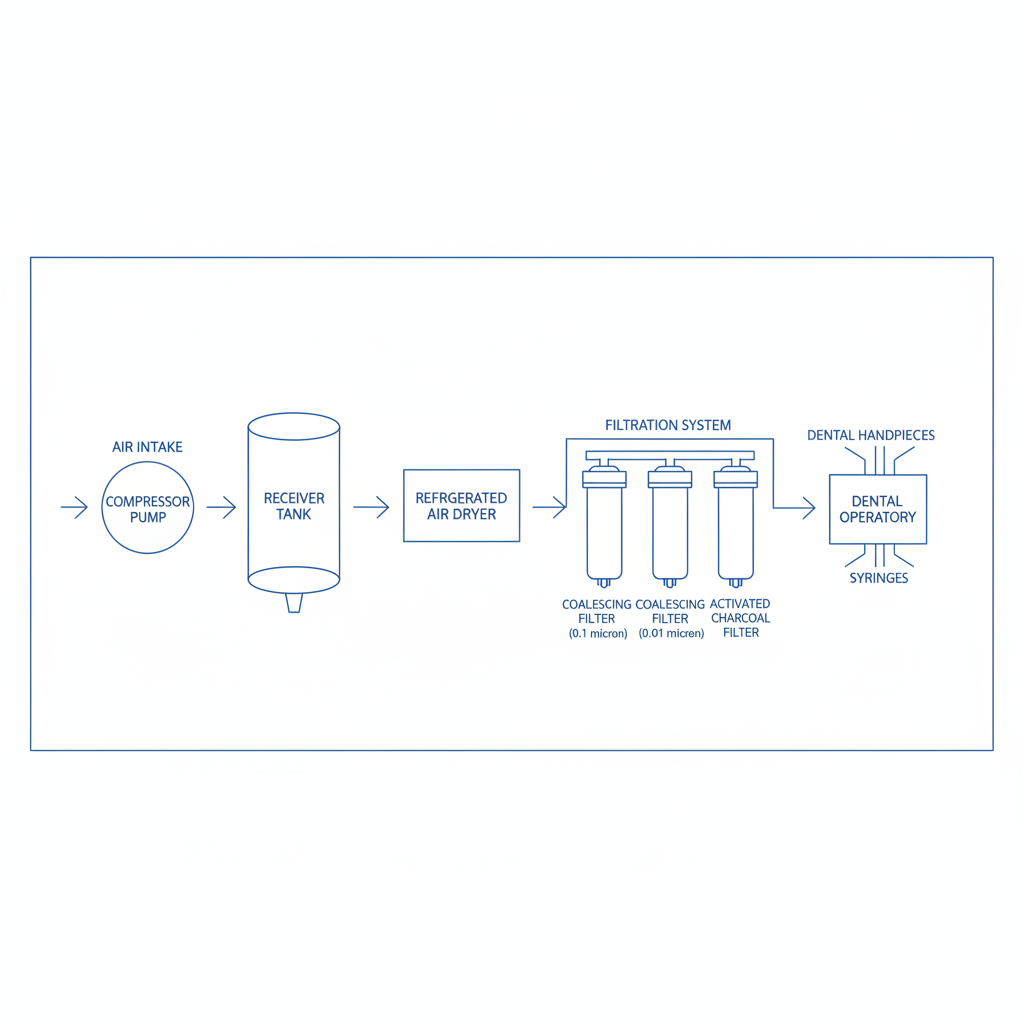
A dental air system is more than just the compressor motor. The supporting components are critical for delivering clean, dry air and ensuring system longevity.
Air Receiver Tank
The receiver tank stores compressed air, acting as a buffer to smooth out demand peaks. This prevents the compressor motor from cycling on and off constantly, which reduces wear and tear. A common heuristic from installers is to have 20–50 liters of tank capacity per dental chair. For a 3-chair clinic, a 100-150L tank is a good starting point.
Air Dryer and Filtration
This is non-negotiable in a dental setting. Atmospheric air is full of water vapor, which condenses when compressed. This moisture will corrode your instruments and can compromise restorative bonding. An air dryer, typically a refrigerated or desiccant type, removes this water vapor. This is a critical step for compliance with regulations like the FDA’s 21 CFR Part 820, which governs medical device manufacturing and performance standards. Coalescing filters installed after the dryer remove oil aerosols and particulates, ensuring the air is clinically pure.
Piping and Redundancy
Even the best compressor is useless if the air can’t get to the operatory efficiently. Use properly sized piping to keep pressure drop below 0.5 bar across the entire system. For clinics where downtime is not an option, consider a duplex system with two smaller compressors. This provides built-in redundancy; if one unit is down for maintenance, the other can handle the clinic’s essential needs.
Wrapping Up: Key Takeaways
Choosing the right dental air compressor is a technical decision that should be driven by data, not guesswork. A properly sized system is a reliable asset that protects your expensive instruments and ensures consistent clinical outcomes.
Here are the key takeaways for your decision-making process:
- Size for Peak Demand: Never use average consumption figures. Sum the peak requirements of your tools.
- Be Realistic: Apply a diversity factor to model concurrent use accurately.
- Plan Ahead: Add a 25-30% safety margin to accommodate future growth and ensure reliability.
- Think Systematically: A compressor is part of a system. The receiver tank, dryer, and filters are just as critical as the pump itself.
By following this framework, you can confidently select a compressor that meets your clinic’s needs today and supports its growth for years to come.
Disclaimer: This article is for informational purposes only and does not constitute professional engineering or medical advice. Always consult with a qualified equipment specialist and adhere to all local regulations and manufacturer specifications when designing and installing a medical gas system.
References
About the Author